 Odita Sunday




By Odita Sunday
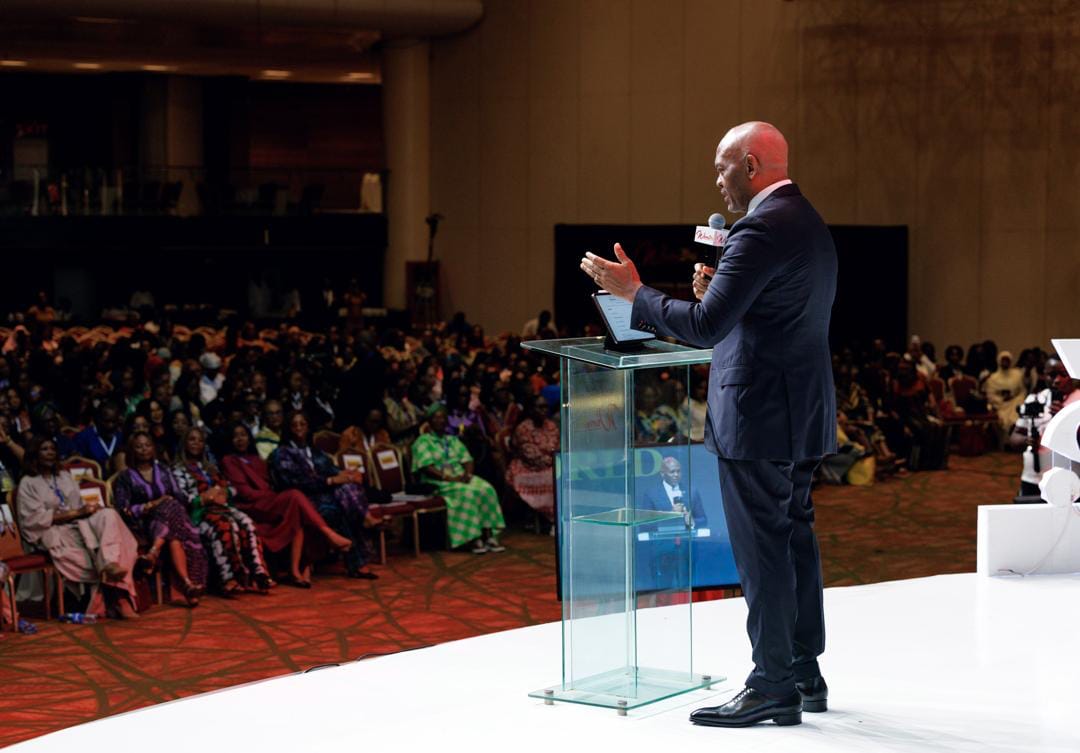
The Group Chair of Heirs Holdings, Transcorp and Founder of the Tony Elumelu Foundation, Tony O. Elumelu, CFR, has said the world needs what Africa has, and that the most valuable asset on the continent is its people, particularly its women.
Elumelu spoke on Friday, November 6, 2026, at the WIMBIZ Annual Conference held at Eko Hotel & Suites, Victoria Island, Lagos.
The conference, marking 25 years of WIMBIZ, was themed: “The Geography of Opportunity: Why The World Needs What Africa Has,” with the sub-theme, “Rooted, Rising, Ready: Born in Africa, Built for the World.”
He said he did not see an audience in the room, but capital, human capital, the most under-deployed asset on the continent.
Recalling his own geography, Elumelu said he did not start with capital, but with a mother who ran a small restaurant and worked harder than anyone he had known. He said his first business school, and his first lessons in risk, cash flow and customers, came from a woman.
“When people ask me whether women can lead African business, I find the question strange. In my experience, they already do. We have simply not given them the capital, the title or the credit,” he said.
He recalled that at 34, he led a small group of young Nigerians to buy a struggling bank that almost nobody else wanted, which became the foundation of everything that followed.
“I call this democratising luck. Opportunity in Africa is still distributed by accident of birth, of geography, of gender. My life’s work is to make it distributed by merit instead,” he said.
Elumelu said by 2050, Africa’s working-age population will grow by hundreds of millions, while the continent holds the minerals that will power the energy transition, the land, the sun, the rivers and the youngest population on earth.
“This is the single greatest commercial opportunity of this century, and it is ours. But potential is not guaranteed,” he said.
He cited Singapore and South Korea as countries with limited resources that transformed themselves, contrasting them with Africa, blessed with mineral wealth, agricultural potential and a rapidly expanding consumer market, yet with too many people trapped in poverty and too many young people seeing emigration as their most credible economic strategy.
He identified three things standing between Africa and its potential: power, value and capital.
“We cannot talk about industrialisation without fixing electricity. Factories cannot run without it. Hospitals and schools cannot function without it,” he said, adding that the AI economy needs power and connectivity.
On value, he said for a hundred years, the question asked of Africa has been how much can be extracted. He said the question must change to how much value can be created here, through refining, processing and branding raw lithium, cocoa and crude before selling to the world.
On capital, he said aid budgets collapsed in 2025 and fell again this year, noting that aid at its best kept people alive, but rarely made them owners. He said the future is investment and trade, not aid, and that capital needs to be African, built on savings, consistent policy and trusted financial institutions.
He cited Seplat’s growth, with share price moving from £3 to £9 and market capitalisation now $7 billion, and Alhaji Aliko Dangote’s mobilisation of retail African investors for the Refinery IPO, as signs of a new dawn.
He added a fourth point: Africa must trade with itself. He said it is easier today to ship goods from Lagos to Liverpool than from Lagos to Luanda, with less than a fifth of Africa’s trade with itself. He said the African Continental Free Trade Area will remain a document until businesses use it, supported by roads, railways, ports, payment systems, efficient customs and predictable regulations.
On inclusive prosperity, Elumelu gave figures from the Tony Elumelu Foundation. He said over 15 years, he and his wife, Dr Awele Elumelu, have put more than $120 million of seed capital into 24,633 young entrepreneurs in all 54 African countries.
He said 48 per cent of them are women, not because of a quota, but because selection is objective and judged on the quality of the business plan alone. Those entrepreneurs, he said, have created more than 1.5 million jobs and generated more than $4.2 billion in revenue.
He named three beneficiaries: Princess Adeyinka Tekenah, who received $5,000 in 2015 and built Happy Coffee, buying beans from women farmers in Taraba State, creating more than 1,000 jobs; Olamide Ayeni-Babajide, who took $5,000 in 2016 and built a recycling company from tyre waste, with revenue up more than twenty-fold and 15,000 people trained, most of them women and girls; and Nkem Okocha, who received $5,000 in 2015 and built Mama Moni, a fintech social enterprise closing the credit gap for low-income female entrepreneurs.
“Three women. Fifteen thousand dollars between them. Thousands of jobs. Now tell me the world does not need what Africa has,” he said.
He disclosed that this year, 265,529 young Africans applied to the programme, but only 3,200 could be funded, just one in every 83 applicants. He said that is not a shortage of talent, but a shortage of capital.
“Women’s economic leadership is not a concession to fairness. It is a requirement for competitiveness. No serious economy can afford to systematically underutilise half its talent,” he said.
Elumelu said he should be judged by what he has done, starting at home with his wife, Dr Awele Elumelu, co-founder of Heirs Holdings, who chairs Avon HMO, Avon Medical, Heirs Insurance Brokers, Transcorp Hotels PLC, and Heirs Energies, now the 6th biggest producer of oil in Nigeria with 70,000 barrels per day.
He recalled appointing Owen Omogiafo in 2020 as President and Group Chief Executive of Transcorp Group PLC, the youngest chief executive on the Nigerian Stock Exchange and the first woman to run Transcorp in its history.
He said by the time Owen took the top job, women held 80 per cent of senior management positions at Transcorp.
He listed eight female leaders as Chairperson/CEOs in the Heirs Holdings Group, including Agatha Obiekwugo, Owen Omogiafo, Uzo Oshogwe, Somachi Chris-Asoluka, Catherine Nwosu, Dr Odiri Ogini, Adetola Fasuyi and Esther Adeola Balogun, and eight female CEOs across UBA Group in Africa.
“If Tony Elumelu can do it in power, in hospitality, in banking, in insurance, in healthcare, and in oil and gas, what exactly is my excuse?” he asked chairmen and chief executives.
On institutions, Elumelu said investors ask the same questions everywhere: Will the contract be honoured? Will the regulator be predictable? Will the courts work? Will the power stay on?
“You do not need to fly around the world asking investors to come. Create the right conditions, and they will come,” he told policymakers.
He added that institutions are not only built by governments, but also by the private sector, through paying taxes properly, publishing accounts, promoting on merit and refusing shortcuts.
In his closing, he urged women not to wait their turn, but to build the business, take the board seat, deploy the capital and hire the girl from the village.
“Advocacy got women into the room. Capital will get them to the head of the table. We have funded 13,360 African female entrepreneurs; I look forward to funding many more,” he said.
“Born in Africa. Built for the world. The world needs what Africa has. And what Africa has, more than oil, more than lithium, more than land, is you,” he said.
About the Author