 Odita Sunday


Gen Olufemi Oluyede, Chief of Defence Staff, Armed Forces of Nigeria The Architect of Integrated Defence
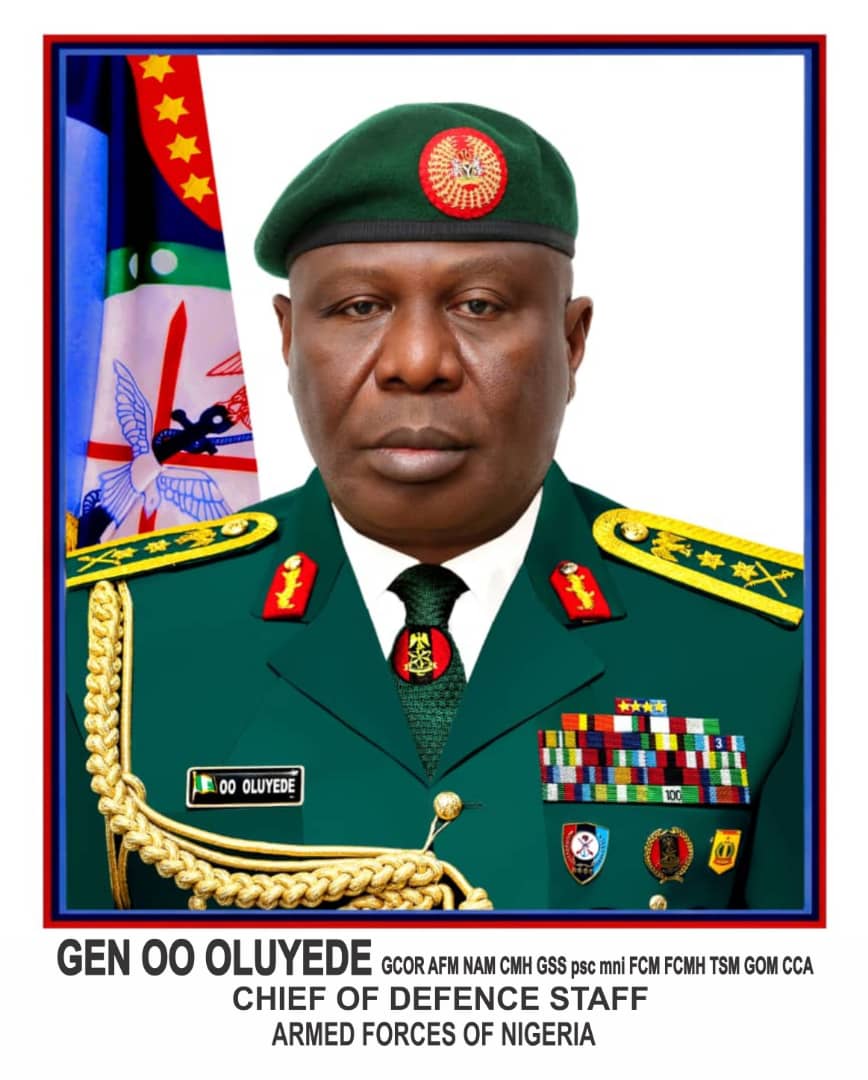
The appointment of General Olufemi Oluyede as Chief of Defence Staff in October 2025 follows a familiar pattern in military systems under strain. When complexity outgrows siloed command structures, states turn to officers who have traversed multiple operational domains and understand the friction between them. Having previously served as Chief of Army Staff, Oluyede arrives at the apex of the defence hierarchy with a reputation forged in infantry command, counter-insurgency theatres and inter-agency coordination. His elevation is less a promotion in rank than a consolidation of function: the attempt to turn three services into one instrument.
The Armed Forces of Nigeria is an institution tasked with confronting a security environment that is simultaneously rural and urban, kinetic and informational, domestic and transnational. The logic guiding Oluyede’s tenure is that such a landscape cannot be managed through parallel chains of command. It requires fusion.
Admitted into the Nigerian Defence Academy in 1987 as part of the 39th Regular Course, he earned a Bachelor’s degree in Economics, later followed by a Master’s in the same discipline. This academic foundation has shaped a particular sensibility: a tendency to view military power not only as force projection but also as resource allocation under constraint. Ammunition stocks, troop rotations, equipment maintenance and logistics chains are, in this reading, not merely operational details but variables in a broader equation of national capacity.
His professional military education reinforced this analytical orientation. Training at the Nigerian Army School of Infantry in Jaji, attendance at the Armed Forces Command and Staff College and participation in the National Institute for Policy and Strategic Studies in Kuru provided successive layers of doctrinal and policy literacy. The cumulative effect is an officer equally conversant in field command and institutional design, comfortable moving between battlefield imperatives and the language of national planning.
Commissioned into the Infantry Corps in 1992, Oluyede’s early exposure came through peacekeeping operations in Liberia under the Economic Community of West African States Monitoring Group (ECOMOG). In that theatre, the distinctions between combatant and civilian were often unstable, and the demands of urban peace enforcement required a careful balance of force and restraint. These early lessons in civil–military coordination would recur throughout his career.
Subsequent deployments in the Bakassi Peninsula under Operation Harmony IV placed him at the intersection of territorial dispute and local identity politics. Here, the challenge was less about defeating an enemy than stabilising a contested space. The experience reinforced a recurring theme in his career: that security is often less about decisive battles than about sustained management of tension.
His tenure as General Officer Commanding 6 Division in the Niger Delta further deepened this perspective. Tasked with protecting critical energy infrastructure in a region long afflicted by militancy and oil theft, he oversaw efforts to restructure patrol patterns and expand community engagement frameworks. The objective was not only to suppress illicit activity but also to reduce the conditions that enabled it. In practical terms, this meant combining kinetic patrols with intelligence gathering and local stakeholder engagement—a recognition that force alone could not secure pipelines or stabilise communities.
It is, however, in the north-eastern theatre that Oluyede’s operational identity was most sharply tested. Serving as Commander of the 27 Task Force Brigade and later as Sector Commander under Operations Lafiya Dole and Hadin Kai, he operated at the centre of Nigeria’s counter-insurgency campaign against jihadist networks. From bases such as Buni Yadi and Damaturu, his formations conducted operations to disrupt insurgent mobility and dismantle logistical networks embedded in the Sambisa Forest and the Lake Chad Basin.
The operational emphasis during this period shifted increasingly towards integration. Air-ground coordination, intelligence fusion and rapid-response capabilities became central to his approach. Rather than treating insurgent groups as static targets, his command structure sought to track movement, anticipate displacement and apply pressure across multiple vectors simultaneously. The results, while uneven—as all counter-insurgency outcomes inevitably are—contributed to the degradation of organised enemy formations and increased instances of surrender and reintegration.
His appointment as Chief of Defence Staff represents an attempt to scale these principles across the entire defence architecture. The challenge is fundamentally different: coordination not within a theatre but across services. The Army, Navy and Air Force each possess distinct operational cultures, procurement systems and intelligence frameworks. Historically, this has produced gaps in communication and duplication of effort. Oluyede’s mandate is to reduce those gaps without erasing institutional identity.
The conceptual shift is towards jointness as the default rather than the exception. Under his leadership, operations are increasingly structured around integrated planning cells, shared intelligence platforms and combined deployment frameworks. The logic is simple: threats do not respect service boundaries, and responses that do are inherently limited.
This approach has already been reflected in recent operational responses. Following a major abduction incident in Oyo State in 2026, he authorised a rapid, multi-domain deployment involving Special Forces units supported by aerial surveillance assets. Rather than relying on conventional patrol patterns, the operation prioritised real-time intelligence tracking and coordinated interdiction. It illustrated a broader shift away from sequential response models towards simultaneous, layered action.
Equally significant has been his emphasis on civil-military coordination at the state level. Engagements with governors, including public recognition of logistical support provided by state governments in volatile regions such as Zamfara, signal an acknowledgement that federal force alone cannot stabilise complex environments. Security, in this framing, is a shared enterprise between federal command structures and subnational governance.
Another recurring theme in his leadership philosophy is troop welfare. Often treated as a secondary concern in operational discourse, welfare has been reframed under his tenure as a determinant of combat effectiveness. Medical evacuation systems, accommodation standards and deployment cycles are not merely administrative matters but determinants of morale, readiness and long-term sustainability. In extended campaigns, fatigue is as decisive an adversary as any armed group.
His service has been recognised through numerous military decorations, including the Grand Service Star, the Corps Medal of Honour and the Field Command Medal of Honour, alongside commendations for institutional leadership. Such honours, while ceremonial in form, reflect sustained engagement across multiple operational domains over decades of service.
A useful way to understand the shift he represents is to contrast older and emerging models of defence management. Traditional structures tended to operate in silos, with limited intelligence sharing and reactive deployment patterns. Joint operations, where they existed, were episodic rather than structural. By contrast, the emerging model under Oluyede prioritises integration: unified intelligence fusion, proactive deployment strategies and continuous inter-service coordination. Where once coordination was an event, it is becoming a system.
This evolution extends to inter-agency relations as well. The boundary between military operations and civilian governance is increasingly porous, particularly in internal security contexts. Effective response now depends on synchronisation between federal forces, state authorities and intelligence agencies. The emphasis is on alignment rather than parallel effort.
At its core, Oluyede’s approach reflects a recognition that modern defence is less about isolated superiority than about coherent orchestration. The battlefield is no longer confined to physical geography; it extends across information networks, local communities and logistical corridors. In such an environment, fragmentation is a liability.
The broader significance of his tenure lies in timing. Nigeria’s security challenges are becoming more interconnected, not less. Armed groups adapt quickly, shifting tactics and exploiting institutional seams. In response, the state must either deepen coordination or accept diminishing returns from isolated action.
Under the leadership of General Olufemi Oluyede, the direction of travel within the Armed Forces of Nigeria is clear. It is towards a defence posture that treats the services not as separate instruments of power but as components of a single system – disciplined, interoperable and increasingly dependent on shared intelligence
and joint execution.
About the Author