 Odita Sunday


Nigeria Unveils New Rules To Tackle Oil Theft, Tighten Security Oversight
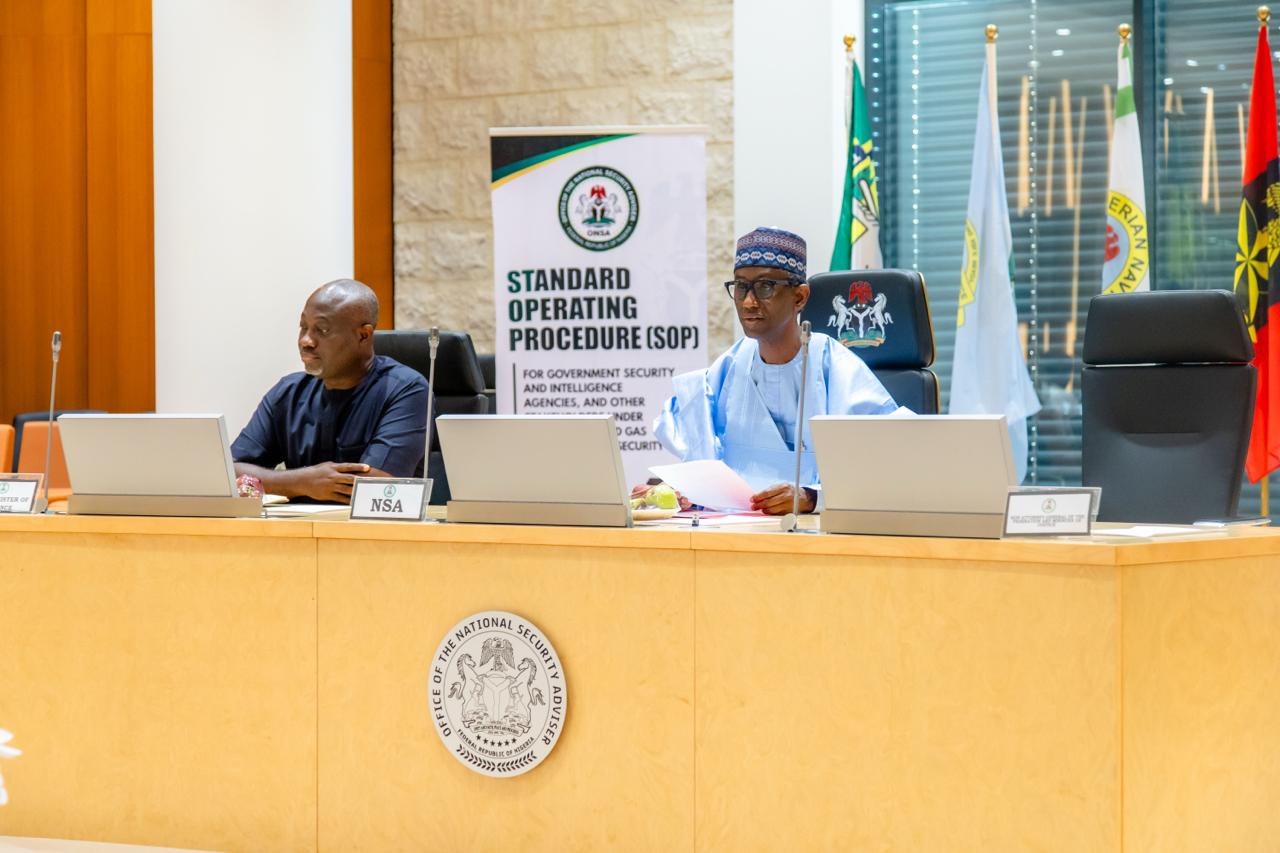
L-R: Representative of the Minister of Defence, Maj. Gen. Olufemi Akinjobi (rtd) and the National Security Adviser (NSA), Nuhu Ribadu.
By Odita Sunday
Nigeria has introduced a new security framework to coordinate the fight against crude oil theft, pipeline vandalism and illegal refining, with fresh guidelines governing the operations of security agencies, oil industry operators and private surveillance contractors.
The Standard Operating Procedure (SOP), launched on October 12, 2026, under the Nigerian Oil and Gas Industry-Wide Security Architecture, sets out how participating institutions should share information, coordinate operations and account for their actions while protecting the country’s oil and gas infrastructure.
National Security Adviser Nuhu Ribadu, who led the initiative, said crude oil theft, pipeline vandalism and illegal refining remained threats to national security, environmental protection and economic recovery.
He called on participating institutions to ensure that the new procedures were communicated to their commands, field operatives and other relevant personnel, stressing that the framework would only deliver results if its provisions were understood and consistently applied.
Ribadu identified professionalism, information sharing, respect for institutional responsibilities and compliance with the law as essential to effective implementation.
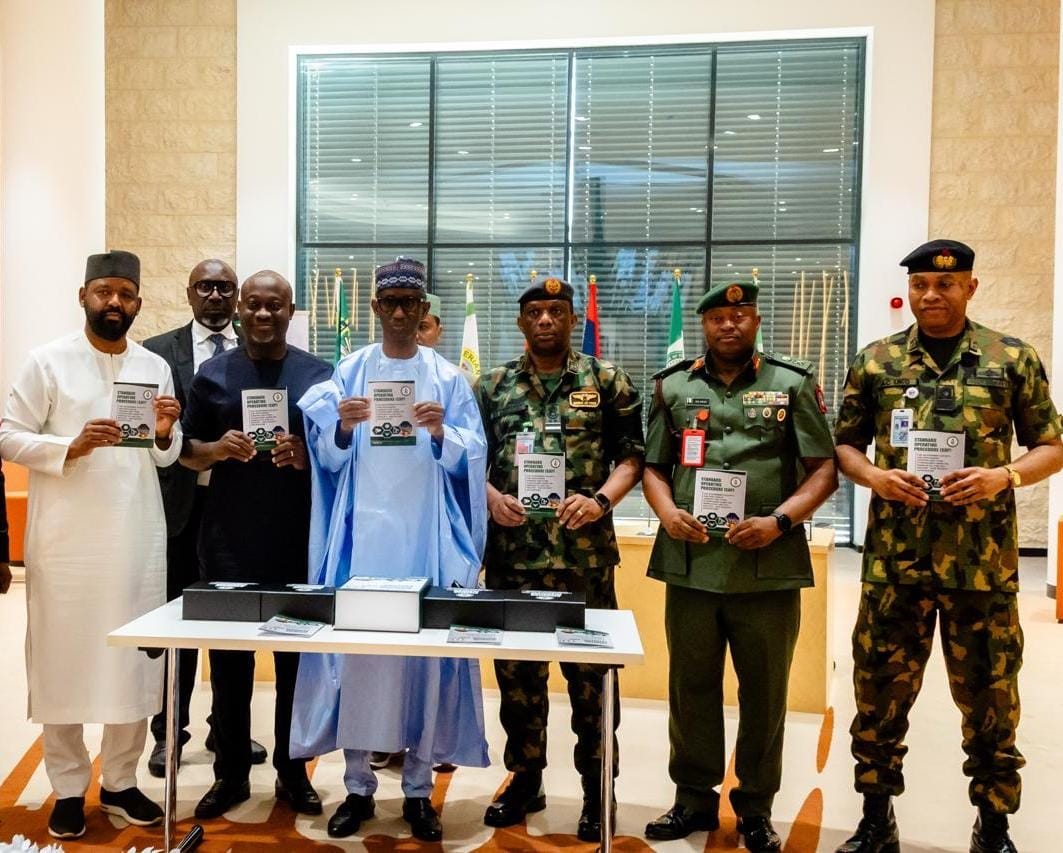
The launch brought together key government and industry figures, including Minister of Defence General Christopher Musa (rtd), Chief of Defence Staff General Olufemi Oluyede and Group Chief Executive Officer of NNPC Limited, Engr. Bashir Bayo Ojulari.
Musa described the initiative as another milestone in efforts to protect Nigeria’s petroleum assets, while Oluyede said clearly defined responsibilities would help security agencies work together without exceeding their respective mandates.
He noted that a common understanding of what each institution was expected to do, how to perform its duties and when to act would bring greater order to security operations.
Ojulari linked improved security around oil facilities to higher production, government revenue, investor confidence and the welfare of host communities.
He recalled that Nigeria’s crude oil and condensate production had fallen to about 950,000 barrels per day in August 2022, when pipeline disruptions and significant discrepancies between crude volumes injected into pipelines and those received at terminals posed major challenges.
According to Ojulari, collaborative security operations have resulted in the deactivation of more than 10,000 illegal refining sites, the removal of nearly 7,000 illegal connections, the recovery of over 2.4 million barrels of stolen crude oil and the apprehension of more than 3,700 suspects.
He said production had subsequently risen above 1.7 million barrels per day, with improved availability of major trunklines.
The figures were presented by the NNPC chief executive as evidence of progress made through cooperation among security agencies and industry stakeholders.
However, Ojulari proposed a 60-day period for stakeholders to review certain provisions of the SOP and strengthen institutional alignment.
He explained that NNPC Limited’s responsibilities under the framework would be subject to its established internal approval procedures, including board consideration where required. Proposed amendments to the SOP are to be channelled through the Office of the National Security Adviser in consultation with relevant stakeholders
The framework clarifies the relationship between government security agencies and private surveillance contractors, whose responsibilities include surveillance, intelligence gathering, technology support and engagement with host communities.
While recognising the contribution of contractors, the SOP requires their overt operations to be conducted jointly with government security agencies. Participating institutions are also expected to operate within the powers and responsibilities established by law and their relevant agreements.
The guidelines extend enforcement beyond the physical theft of petroleum products to activities involving their storage, transportation, marketing, sponsorship and financing.
They also establish procedures for documenting arrests, preserving evidence and transferring suspects and recovered items to designated government authorities.
Arrests must be verified, documented and reported through the Command-and-Control Centre, while contractors are required to hand over arrested persons and recovered assets to the appropriate government authorities as soon as practicable.
The framework provides for the preservation of exhibits, witness statements and physical or digital evidence to support investigations and prosecutions.
It also recognises the rights of arrested persons, including protection from torture and degrading treatment, information about the reasons for arrest, the right to remain silent, access to legal representation and humane conditions of custody.
The Commandant-General of the Nigeria Security and Civil Defence Corps, Ahmed Audi, reaffirmed the corps’ responsibility for protecting oil and gas infrastructure.
He disclosed that several officers found guilty of misconduct in the Niger Delta had been dismissed, underscoring the need for accountability among personnel entrusted with safeguarding national assets.
Meanwhile, Captain Warredi Enisuoh, Executive Director, Operations and Technical, Tantita Security Services Nigeria Limited, called for wider distribution of the SOP, including to educational institutions, to improve understanding of infrastructure protection.
Enisuoh said the operational gains recorded before the manual’s launch demonstrated the value of collaboration. He expressed confidence that the new framework would support further improvements.
He also said Tantita’s command-and-control centre had the capacity to monitor activities beyond Nigeria’s exclusive economic zone and pledged to use that capability to support implementation and share information with Nigerian security forces.
Hafsat Bakari, Chief Executive Officer and Director of the Nigerian Financial Intelligence Unit, described the framework as an important technical and compliance milestone.
She called for monitoring arrangements and feedback mechanisms to assess implementation, identify gaps and determine whether the new procedures were delivering practical results.
The SOP also establishes guidelines for coordinated patrols, pipeline surveillance, drone operations and the recovery and evacuation of stolen petroleum products.
Drone operations are subject to relevant permissions, safety requirements and coordination with aviation and security authorities. The recovery and evacuation of petroleum products involve designated security agencies, regulators and environmental authorities, with procedures for verifying quantities and quality.
The framework further addresses public communication about security operations and encourages engagement between industry operators, contractors and host communities.
Its implementation will be important in determining whether improved coordination translates into more reliable oil infrastructure, stronger environmental compliance, effective prosecutions and greater accountability in the protection of Nigeria’s petroleum assets.
The article was authored by Chido Onumah, PhD, Special Adviser to the National Security Adviser on Strategic Communication and Civil Society Liaison.
About the Author