 Odita Sunday

IGP Egbetokun, Peace Scholars Chart New Path for Police Leadership Amid Security Pressures
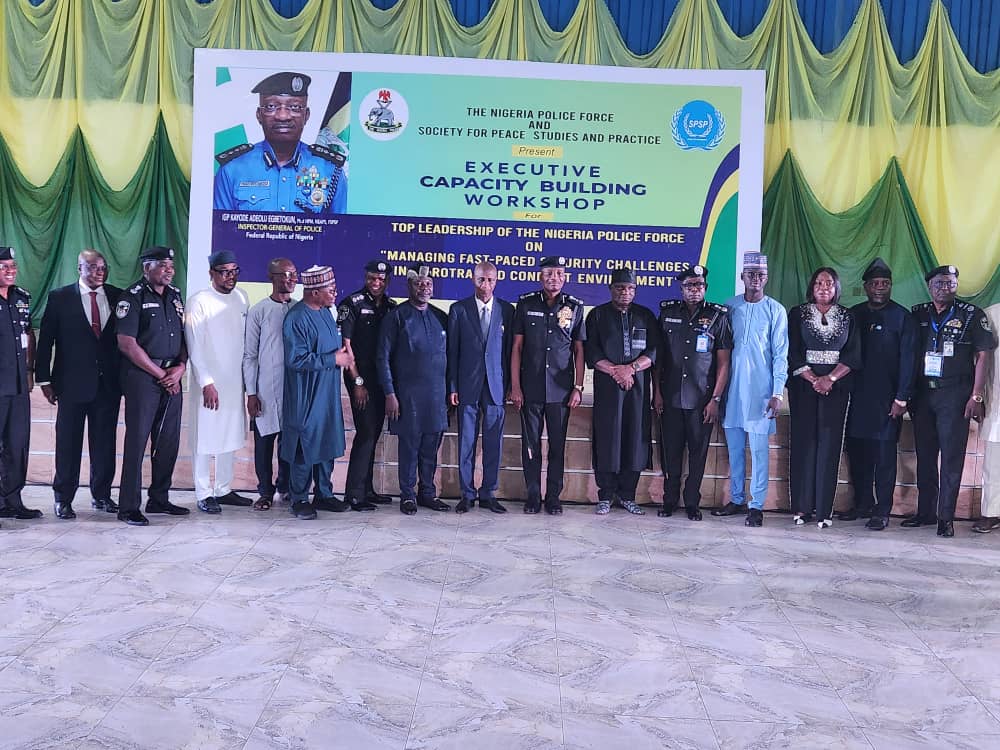
The Inspector-General of Police, IGP Olukayode Adeolu Egbetokun, on Monday declared open an Executive Capacity Building Workshop for the top leadership of the Nigeria Police Force (NPF), describing it as a timely intervention in an age of fast-paced, unpredictable security challenges.
Speaking at the Police Resource Centre, Jabi, Abuja, Egbetokun warned that conflicts in Nigeria no longer wait for conventional responses, stressing that law enforcement must adapt with speed, foresight, and creativity.
“Conflicts no longer wait. Neither can we,” he said pointedly. “Security challenges no longer unfold at a measured pace; they emerge suddenly, evolve rapidly, and persist stubbornly. If we must win, our leadership must be faster, sharper, and more innovative than the threats we confront.”
The IGP commended the Society for Peace Studies and Practice (SPSP) for partnering with the police on the initiative, which he said bridges the gap between scholarship and practice. “By creating this platform, SPSP has given us not just an opportunity to reflect, but also to renew and sharpen our leadership for the complex challenges ahead,” he added.
The workshop, themed “Managing Fast-Paced Security Challenges in a Protracted Conflict Environment”, was described by the police chief as “apt and urgent.” According to him, criminal syndicates are exploiting technology, terrorist networks are reorganising under new labels, and once-local conflicts are spilling across borders, amplified by social media.
“This complexity demands more than courage alone,” Egbetokun told participants. “It demands foresight, creativity, and the agility to lead in an environment of constant flux.”
The one-day training covered critical topics such as conflict analysis, conflict-sensitive decision-making, early warning and early response systems, and linking early warning to policy development.
“These are not abstract concepts,” the IGP explained. “They are practical weapons of leadership—tools that will equip you to command with clarity, manage crises with precision, and inspire confidence in the men and women under your charge.”
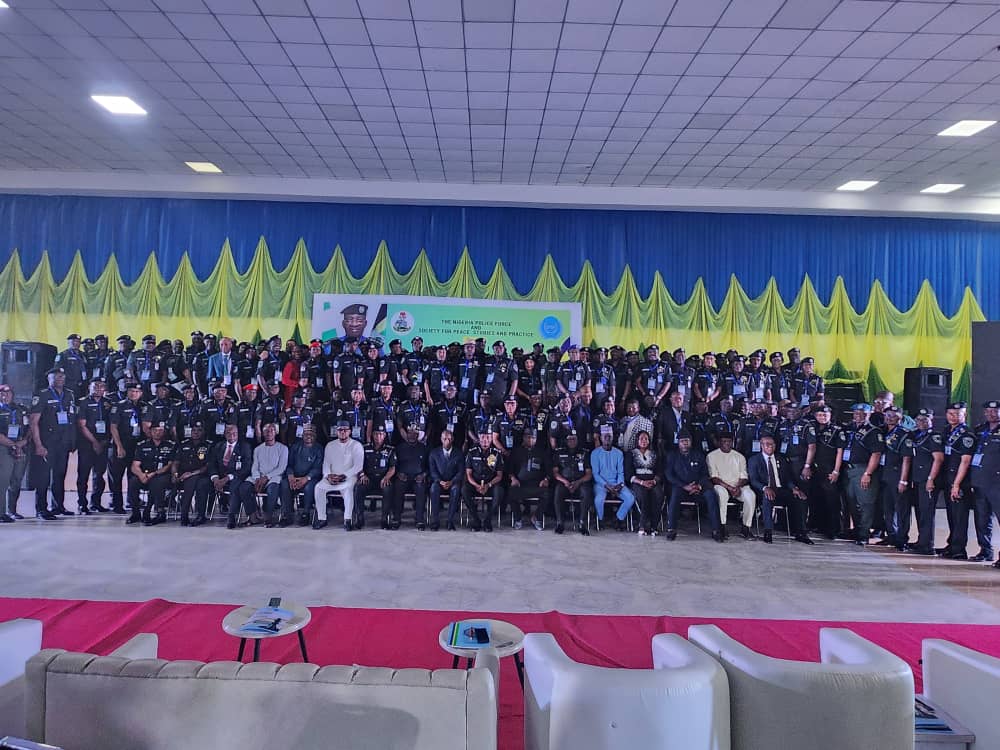
Earlier, the President of SPSP, Nathaniel Msen Awuapila, FSPSP, underscored the gravity of the moment, noting that Nigeria is at a crossroads where policing must evolve into a proactive, intelligence-driven institution.
“It is both a privilege and a solemn responsibility to welcome you to this Executive Capacity Building Workshop,” Awuapila said. “We are gathered here not merely to exchange ideas, but to embark on a transformative journey, one that seeks to reposition the NPF as a force capable of fostering peace, justice, and national cohesion.”
He stressed that the programme aligns with the National Security Strategy, the ongoing Police Reform Agenda, and global peacebuilding frameworks. “Through expert presentations, interactive sessions, case studies, and dialogue, we aim to equip senior officers not just with tactical proficiency, but with strategic insight to lead with integrity and impact,” he added.
The joint message from both leaders was clear: police reform is no longer optional but urgent. The scars of past crises—ranging from insurgency in the North-East, to violent banditry, to community-police tensions—have made it necessary to rethink leadership at the top.
The IGP cautioned that the workshop must not end with lectures and notes. “It must produce a shift in mindset, a recalibration of strategy, and a renewal of commitment,” he charged. “Every insight must become an action, and every action must strengthen the chain of security that binds our nation together.”
Both the IGP and SPSP stressed that the ultimate test of the workshop will not be in the hall but in Nigeria’s streets and communities.
“Our success will not be measured by the brilliance of one commander or the courage of a few units, but by the strength of our collective capacity to anticipate threats, respond as one body, and deliver security Nigerians can see and feel every day,” Egbetokun declared.
With Nigeria facing multiple layers of insecurity, the Abuja engagement may be remembered as one of the steps toward building a more resilient and forward-looking police force, one that balances strength with strategy, and power with principle.
“Let every lesson you gain here become a weapon in your armoury,” the police boss told his officers, “every idea, a strategy for tomorrow, and every decision you take henceforth a testament of the leader you have chosen to become.”
About the Author