
 Odita Sunday



Beyond 70 Years: How the Nigerian Navy Is Expanding the Fight Against Piracy Across the Gulf of Guinea
By Nzubechukwu Ezeobi
As the Nigerian Navy marks its 70th anniversary, the celebration is not merely about longevity. Rather, it is an opportunity to reflect on a remarkable maritime security achievement that has transformed Nigeria’s reputation in global shipping circles: five consecutive years without a recorded case of piracy in Nigerian waters.
For decades, the Gulf of Guinea was
notorious as one of the world’s most dangerous maritime corridors, accounting for a significant proportion of global piracy incidents. Today, however, Nigeria’s waters tell a different story, one that naval authorities believe demonstrates the growing effectiveness of maritime security operations and regional cooperation.
At the centre of this evolving narrative is Commodore Mohammed Segir Shatima, Commander of the Combined Maritime Task Force for the Gulf of Guinea, who sees the Navy’s platinum jubilee as more than a ceremonial milestone.
“I think 70 years in the life of anyone or anything is a big milestone,” he said. “But beyond the celebration, we need to celebrate the fact that this is the fifth consecutive year that we have not
recorded any case of piracy in Nigerian waters.”
A Victory Beyond Borders
The achievement did not happen in isolation. According to maritime security experts, the fight against piracy requires constant vigilance and collaboration because criminal activities at sea rarely respect national boundaries.
For Commodore Shatima, this reality underscores the importance of international maritime cooperation.
“The maritime environment by nature is transnational,” he explained. “Any effort to bring stakeholders together to exercise and complement each other’s capabilities is a significant step towards achieving the
overall aim of securing the maritime space.”
Unlike land borders, maritime domains are fluid and interconnected. Criminal networks often exploit jurisdictional gaps, moving across territorial waters to evade enforcement. This challenge has made cooperation among Gulf of Guinea nations increasingly critical.
The Combined Maritime Task Force, which Shatima commands, was established with this understanding. Its objective is to create a framework through which countries in the region can collectively address maritime threats and respond rapidly to security incidents.
From National Success to
Regional Ambition
While acknowledging Nigeria’s progress, the naval commander was careful not to overstate the country’s standing on the global stage.
“I think saying we are one of the best in the world is an overkill,” he remarked with characteristic candour. “We are one of the best in the region, or the best in the region, to be modest and sincere to ourselves.”
That humility, however, does not diminish the significance of what the Navy has accomplished.
The elimination of piracy from Nigerian waters represents a major operational success for a country that once battled persistent attacks on merchant vessels,
offshore installations and fishing communities. The result has been improved confidence among international shipping companies and enhanced maritime trade.
Yet, for naval authorities, securing Nigerian waters alone is not enough.
“Because of our peculiar position in the region, we want to extend this safety and security beyond Nigerian waters to our neighbouring waters,” Shatima said. “If your neighbour’s house is on fire, don’t laugh; assist him. You don’t know when next this will come to you.”
This philosophy has become a guiding principle for Nigeria’s regional maritime engagement. Security planners increasingly recognize that instability in
neighbouring waters can easily spill into Nigeria’s maritime domain.
The Deep Blue Effect
One of the most discussed initiatives in recent years has been Nigeria’s Deep Blue Project, designed to strengthen maritime surveillance and response capabilities.
While acknowledging the project’s contribution, Shatima was unequivocal about who deserves primary credit for the anti-piracy successes recorded so far.
“The Deep Blue Project supports maritime security operations, but fighting piracy is the primary role of the Nigerian Navy,” he stated. “When you say there is no piracy in Nigeria, the credit goes to the Nigerian Navy.”
Nevertheless, he noted that the project has provided valuable support to the Navy and other maritime stakeholders, enhancing operational effectiveness and strengthening overall maritime governance.
The synergy between the Navy and supporting agencies has been instrumental in sustaining gains achieved over the past five years.
Building a Regional Security Architecture
The next phase of the strategy focuses on expanding collaborative security efforts across the Gulf of Guinea.
According to Shatima, six countries have
already indicated interest in participating in the Combined Maritime Task Force framework. These include Ghana, Gambia, Sierra Leone, Liberia and Cote d’Ivoire, alongside Nigeria.
The growing coalition reflects a shared understanding that maritime security is inseparable from economic prosperity.
The task force’s motto, “Collaborative Security for Collective Prosperity,” encapsulates this vision.
By pooling resources, sharing intelligence and coordinating naval deployments, participating nations hope to create a security architecture capable of denying criminal groups the freedom to operate across the region’s waters.
Looking Ahead
Asked where he sees the mission in the next five years, Shatima declined to make bold predictions, preferring instead to focus on measurable progress.
“Time will tell,” he said.
Yet he remains optimistic about the near future.
“It is obvious that even in the next six months, we will begin to hear positive news of rapid deployment of naval forces across the entire Gulf of Guinea.”
For a region once synonymous with piracy and maritime insecurity, such optimism reflects how far things have changed.
As the Nigerian Navy celebrates seven decades of service, its greatest legacy may not simply be the protection of Nigeria’s territorial waters. Rather, it may be its emerging role as a regional leader in building a safer and more secure maritime environment across West and Central Africa.
The journey from national success to regional stability is far from complete. But after five years without piracy in Nigerian waters, naval authorities believe the foundation has already been laid for a more secure Gulf of Guinea-one where collaboration, rather than confrontation, becomes the defining force on the horizon.
Story 2
From the Gulf of Guinea to Global Waters: NNS Kada Returns with a Story of Readiness, Resilience and Maritime Prestige
By Nzubechukwu Ezeobi
As dawn broke over the harbour, the unmistakable silhouette of Nigerian Navy Ship (NNS) Kada emerged on the horizon, cutting through the calm waters with quiet authority. To the casual observer, it was simply a naval vessel returning home. But for the officers and ratings aboard, the homecoming marked the successful conclusion of a mission that showcased Nigeria’s growing maritime influence on the international stage.
Fresh from participating in the International Fleet Review and the
International Maritime Exercise, NNS Kada returned not merely as a ship completing a voyage, but as a floating testament to the Nigerian Navy’s operational competence, strategic relevance and unwavering commitment to maritime security.
The atmosphere aboard the vessel reflected a blend of accomplishment and professionalism. Days of rigorous exercises, multinational engagements and operational drills had reinforced the ship’s role as one of the Nigerian Navy’s most versatile assets.
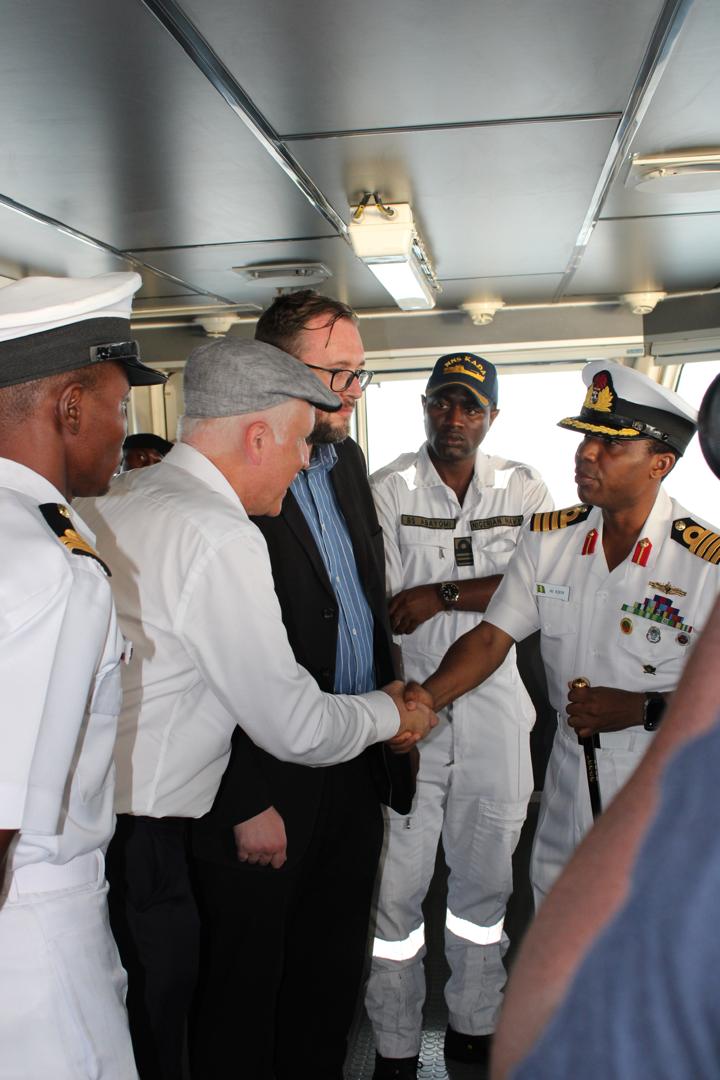
Standing on the expansive deck of the amphibious landing ship transport vessel, the Commanding Officer, Captain Ali Ignatius Ejeh, reflected on the significance of the mission.
For him, the fleet review was far more than a ceremonial gathering of warships. It was an opportunity for the Nigerian Navy to demonstrate before the international community the remarkable progress it has made in securing Nigeria’s maritime domain and contributing to regional stability.
“We have just come back from the International Fleet Review, which enabled the Nigerian Navy once again to show her capabilities to the entire world,” he said.
Those capabilities have become increasingly evident in recent years. Once regarded as one of the world’s piracy hotspots, the Gulf of Guinea has witnessed a remarkable decline in pirate attacks, largely due to sustained maritime security operations and improved collaboration
among regional and international navies.
For Captain Ejeh, this transformation remains one of the Navy’s most significant achievements.
“We have been able to curb piracy to the barest minimum, and this has removed us from the piracy index list,” he noted.
The accomplishment carries implications far beyond military circles. Safer waters have enhanced confidence among international shipping companies, strengthened economic activities and reinforced Nigeria’s reputation as a responsible maritime nation.
Yet the story of NNS Kada extends beyond anti-piracy operations.
Designed as an amphibious platform capable of transporting troops, vehicles and equipment, the vessel occupies a unique position within Nigeria’s defence architecture. Its ability to project military capability from sea to shore has made it an indispensable asset in joint operations across the country.
Whether supporting counter-insurgency campaigns, responding to security emergencies or transporting personnel and logistics, NNS Kada represents the Navy’s expanding role in addressing contemporary security challenges that increasingly blur the line between maritime and inland threats.
Equally significant was the multinational character of the fleet review itself. The gathering brought together naval forces
and maritime stakeholders from across the region and beyond, underscoring a shared recognition that modern maritime threats demand collective responses.
From piracy and sea robbery to illegal fishing and transnational crime, many of the challenges confronting coastal states cannot be effectively tackled by any single nation acting alone.
The exercise therefore served as a platform for strengthening partnerships, building trust and enhancing interoperability among participating navies.
According to Captain Ejeh, the success of the mission was made possible through the support and strategic leadership of the Chief of the Naval Staff, Vice Admiral Emmanuel lkechukwu Ogalla, whose vision
continues to shape the operational transformation of the Nigerian Navy.
But beyond the diplomatic engagements and ceremonial displays, the true essence of naval professionalism unfolded during the long hours at sea.
Life aboard a warship is defined by constant vigilance. Even in moments of apparent calm, preparation never ceases.
Throughout the exercise, the crew of NNS Kada engaged in a series of intensive drills designed to sharpen their readiness for emergencies and operational contingencies. Firefighting exercises tested their ability to respond to onboard incidents. Man-overboard procedures rehearsed rescue operations under pressure. Visit, Board, Search and Seizure
(VBSS) drills strengthened capabilities for maritime interdiction, while specialised activities focused on combating Illegal, Unreported and Unregulated (IUU) Fishing.
The frequent alarm signals that echoed through the vessel during the exercise were not signs of danger but deliberate tests of discipline and preparedness.
“Those alarms were to test the crew and their reaction timings to several eventualities that may occur,” Captain Ejeh explained.
For visitors unfamiliar with naval routines, the sudden alarms and swift movements of sailors may appear dramatic. For the crew, however, they are routine reminders that readiness can never be postponed.
Every drill, every exercise and every response is designed to ensure that when real emergencies arise, hesitation is replaced by instinct and professionalism.
It is this culture of preparedness that remains the backbone of naval effectiveness.
As NNS Kada settled back into harbour after its successful deployment, its return symbolised more than the end of an international engagement. It represented the culmination of months of training, dedication and operational excellence by the men and women who serve aboard her.
In an era of evolving security challenges, the vessel stands as a powerful symbol of Nigeria’s determination to secure its maritime interests, protect vital sea lanes
and contribute meaningfully to regional peace and stability.
For the Nigerian Navy, the voyage may be over, but the mission continues. And as NNS Kada rests at berth, its crew remains ready for the next call to duty-whether on Nigeria’s waters, across the Gulf of Guinea or wherever national interests require their presence.
About the Author